

SITE CLEANUP PROGRAM (SCP)
Formerly Spills, Leaks, Investigations and Cleanups (SLIC)
The objectives of the Los Angeles Regional Water Quality Control Board's site cleanup program are to protect and restore water resources, and to uphold stringent goals to protect human health, water quality and the environment, today and into the future.
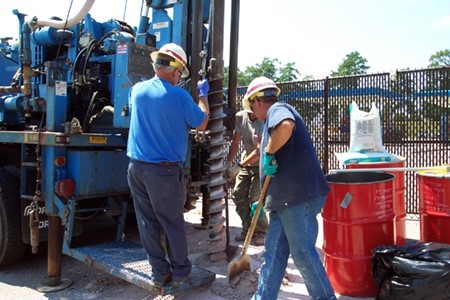
The Site Cleanup Program (SCP) regulates and oversees the investigation and cleanup of unauthorized discharges of pollutants and pollution-impaired sites not overseen by the Underground Tank Program. The primary goal of the SCP is to direct and provide oversight of site investigation and cleanup activities that will result in restoration and/or protection of water quality, human health, and the environment.
The scope of the SCP is not restricted to particular pollutants or environments; it covers all types of pollutants, such as solvents, petroleum fuels, and heavy metals, and all environments, including surface water, groundwater, and the vadose zone (also known as the unsaturated zone extending from the top of the ground surface to the water table).
Upon confirmation that an unauthorized discharge is polluting or threatening to pollute regional water bodies, the Los Angeles Regional Water Quality Control Board (Regional Water Board) has the legal and regulatory authority to oversee site investigations and direct corrective actions. The California Water Code provides authority for the State Water Resources Control Board and the Regional Water Boards to require investigation and cleanup of sites with unauthorized pollutant releases.
Announcements
-
Skypark Commercial Properties Remote Public Meeting-July 30, 2020
- SCP Presentation video
- SCP Q&A Session audio
- SCP Presentation video
-
October 11, 2018 Board Meeting Groundwater Workshop
- Arthur Heath (Section Chief, Site Clean Up, LA Regional Water Boards)
- Cary Wicker (Engineering Geologist, LA Regional Water Boards)
- Division of Financial Assistance
- Division of Drinking Water
- California Communities Against Toxics
- Gary A. Meyer
- Los Angeles Department of Water and Power
- San Gabriel Basin Water Quality Authority
- Water Replenishment District of Southern California
- U.S. EPA
-
The five essential elements of site investigation and cleanup are:
Preliminary site assessment to confirm the discharge and the identity of the dischargers; to identify affected or threatened waters of the state and their beneficial uses; and to develop preliminary information on the nature and vertical and horizontal extent, of the discharge;
Soil and water investigation to determine the source, nature, and extent of the discharge with sufficient detail to provide the basis for decisions regarding subsequent clean-up and abatement actions, if any, are determined by the Regional Water Board to be necessary;
Proposal and selection of clean-up action to evaluate feasible and effective cleanup and abatement actions and to develop preferred cleanup and abatement alternatives;
Implementation of clean-up and abatement action to apply the selected alternative and to monitor in order to verify progress; and
Monitoring to confirm short and long-term effectiveness of the cleanup and abatement.
-
The SCP generally provides oversight for sites and projects involving:
-
Cost Recovery (CR) agreements: Pursuant to Porter-Cologne, Section 13304, reasonable costs for such oversight can be recovered by the Regional Water Board) from the responsible party. Before any oversight work can be done, the responsible party or parties must agree to reimburse the State for costs associated with the investigation and cleanup. Any overhead charges are based on the number of labor hours charged and can consist of rent, travel, training, supplies, and personnel services. If there is no labor charged, there will be no overhead charges. No cleanup oversight will be performed unless the responsible party in question agrees in writing to reimburse the State for appropriate cleanup oversight costs.
Superfund designation, in conjunction with the United States Environmental Protection Agency (USEPA): Since 1980, the USEPA has collaborated with state and local agencies such as this Regional Water Board to protect human and environmental health by managing the cleanup of the most contaminated hazardous waste sites in the United States, known as Superfund Sites. Sites determined to have superfund designation are added to the National Priorities List until cleanup has been completed. A tool for finding current Superfund and Brownfields cleanup projects in California can be found at: https://www.epa.gov/cleanups/cleanups-my-community.
Redevelopment: The Regional Water Board manages cleanup of sites where use or expansion is complicated by environmental contamination, either real or perceived. These sites will be further developed, expanded, or redeveloped for continued or future use after the cleanups have been completed.
Department of Defense (DOD): Decades of defense activities have degraded water quality on and around federally-owned facilities. Working with other agencies, the Regional Water Board is involved with remedial investigation and cleanup actions on more than 16 U.S. Department of Defense (DOD) sites. Agreements with the DOD provide for accelerated cleanups at military bases and other Defense sites scheduled for closure and reuse. Site investigation and cleanup procedures are consistent with State laws and regulations as well as applicable provisions of the Comprehensive Environmental Response, Compensation, and Liability Act (CERCLA). Additional information can be found at: www.waterboards.ca.gov/water_issues/programs/dept_of_defense.
The Above Ground Tank (AGT) Program: Effective January 1, 2008, the Regional Water Board no longer oversees the AGT Program. Certified Unified Program Agencies (CUPA's) are vested with the responsibility and authority to implement the Aboveground Petroleum Storage Act (APSA). Additional Information can be found by visiting http://www.calepa.ca.gov/CUPA/Aboveground/.
The Former Well Investigation Program: The Regional Water Board managed specific investigations into sites potentially impacting drinking water wells. While this program is no longer active, information from the WIP database can be found in the existing GeoTracker database: https://geotracker.waterboards.ca.gov/.
The GeoTracker database (Former SCP database) is the Water Boards' data management system for sites that impact, or have the potential to impact, water quality in California, with an emphasis on groundwater: GeoTracker contains records for sites that require cleanup, such as Leaking Underground Storage Tank (LUST) Sites, Department of Defense Sites, and Cleanup Program Sites. GeoTracker also contains records for various unregulated projects as well as permitted facilities including Irrigated Lands, Oil and Gas production, operating permitted underground storage tanks (USTs), and Land Disposal Sites. To review any files stored on this list, please email a request to: RB4-PublicRecords@waterboards.ca.gov.
The Regional Water Board works closely with the Department of Toxic Substances Control (DTSC). DTSC's EnviroStor Database allows for quick access to vital information about environmental cleanups and permitted facilities in communities. To view a list of DTSC sites, please visit: http://www.envirostor.dtsc.ca.gov/public/.
-
-
Public Participation
Sections 13307.5 and 13307.6 of the California Water Code mandate public participation activities for sites under cleanup and abatement orders (CAOs), and public participation is an integral component of the Site Cleanup Program. The Regional Water Board engages in community outreach, engagement and education, provides timely and ongoing communication, and encourages public comment on Board actions and activities. The level of public participation at cleanup sites is based on potential dangers to human health and water quality, the degree of public interest, and environmental justice concerns.
-
Reference/Guidance Documents
For more information about the Site Cleanup Program, please review the following fact sheets:
- Electronic Submittal of Information (ESI)
- Types of Funding Mechanisms for Cleanup Sites
- Deed Restriction Template PDF | Word
- Underground Storage Tanks (UST)
- General Workplan Requirements for a Heavy Metals Soil Investigation
- Soil Gas Advisory
- Electronic reporting requirements for The Spills, Leaks, Investigation & Cleanup (SLIC), Well Investigation Program (WIP), Department of Defense (DOD), Chapter 15 and Non Chapter 15 Programs.
- Quality Assurance Project Plan (QAPP) for San Fernando Valley/San Gabriel Valley Cleanup Program
LEGISLATION GUIDING CLEANUP AND REMEDIATION
PROPOSITION 65: Proposition 65, the Safe Drinking Water and Toxic Enforcement Act of 1986, was enacted as a ballot initiative in November 1986. The Proposition was proposed by its authors to protect California citizens and the State's drinking water sources from chemicals known to cause cancer, birth defects or other reproductive harm, and to inform citizens about exposures to such chemicals.
Please visit http://www.oehha.ca.gov/prop65.html for additional information.
For a list of chemicals, please review the fact sheet:
SENATE BILL 445: The goal of Senate Bill 445 (SB 445) is to conduct work on impacted sites that would generally fall outside of the cost recovery program. Sites with potential human health impacts due to on-going soil, soil gas, and groundwater contamination, sites with directives or orders (i.e., California Water Code sections 13267 and 13304), sites with limited financial or discretionary resources to fund required investigation work, sites with no known responsible parties, sites in economically disadvantaged areas or small communities, sites impacting water supply wells, sites in communities with limited or no water supply resource, industrial or impacted sites within residential areas, and backlogged impacted cases that fall within the above categories, can apply for financial assistance. Financial assistance under SB 445 is provided through the Site Cleanup Subaccount Program (SCAP). SCAP allows the State Water Resources Control Board to provide funding for projects that remediate the harm or threat of harm to human health, safety, or the environment caused by existing or threatened surface water or groundwater contamination. Addition information regarding SB 445 is available as follows:
For more information about SCAP or to apply for financial assistance, please visit http://www.waterboards.ca.gov/water_issues/programs/grants_loans/scap/or contact the Financial Assistant (Grants & Loan) section at 1-800-813-3863
or email gwquality.funding@waterboards.ca.gov.
SITE CLEANUP CONTACTS:
(213) 576-6725 or Arthur.Heath@waterboards.ca.gov
Jillian Ly, Section Chief
(213) 576-6664 or Jillian.Ly@waterboards.ca.gov
Joshua Cwikla, Unit Chief Site Cleanup I
(213) 576-6735 or Joshua.Cwikla@waterboards.ca.gov
Jeffrey Hu, Unit Chief Site Cleanup II
(213) 576-6803 or Jeffrey.Hu@waterboards.ca.gov
Thizar Tintut-Williams, Unit Chief Site Cleanup III
(213) 576-6723 or Thizar.Williams@waterboards.ca.gov
Angelica Castaneda, Unit Chief Site Cleanup IV
(213) 576-6737 or Angelica.Castaneda@waterboards.ca.gov
Bizuayehu Ayele, Unit Chief Site Cleanup V
(213) 576-6623 or Bizuayehu.Ayele@waterboards.ca.gov
Xiao-Xue Fang (Anita Fang), Unit Chief Site Cleanup VI
(213) 576-6730 or
Xiao-Xue.Fang@waterboards.ca.gov
Water Regulation
Water Code Section 13267 authorizes the Water Boards to require technical reports from suspected dischargers.
Water Code Section 13304 authorizes the Water Boards to issue "cleanup and abatement" orders requiring a discharger to cleanup and abate waste "where the discharger has caused or permitted waste to be discharged or deposited where it is or probably will be discharged into waters of the State and creates or threatens to create a condition of pollution or nuisance." Water Code Section 13304 also authorizes the Regional Water Boards to recover costs for oversight of site cleanup at these sites.
State Water Board Resolution No. 92-49, "Policies and Procedures for Investigation, Cleanup and Abatement of Discharges Under Water Code Section 13304", State Water Board Resolution No. 68-16, "Statement of Policy with Respect to Maintaining High Quality of Waters in California"; and State Water Board Resolution No. 88-63,"Sources of Drinking Water", contain the policies and procedures that all Water Boards shall follow to oversee and regulate investigations and cleanup and abatement activities resulting from all types of discharge or threat of discharge subject to Water Code Section 13304.

