


Napa River Nutrient TMDL
Background
The Napa River and its tributaries provide habitat for a diverse array of aquatic life, including steelhead trout and Chinook salmon. Excessive nutrients (nitrogen and phosphorus) have impaired habitat in this river system as well as detracting from the river's recreational value. As a result, the Napa River is on the U.S. EPA's 303(d) list of impaired water bodies due to nuisance algae growth caused by the excessive concentrations of nutrients. Nuisance algae can impair recreational beneficial uses by creating unsightly and unaesthetic conditions.
Algae also blocks sunlight and, when it decomposes, can deplete the river’s supply of dissolved oxygen, which is essential for aquatic life.
Water Quality Data Collection
During summer and fall in 2011 and 2012, Water Board staff collected and analyzed data on physical habitat and water quality at about 10 sites throughout the Napa River watershed. We measured nutrient levels (nitrogen and phosphorous), the quality of physical habitat (shading, temperature, stream flow) and algae levels (as indicated by the concentration of chlorophyll in samples scraped from stream bed). Because algae can lower night time oxygen levels, we continuously monitored dissolved oxygen at a subset of sites with sampling probes placed in the streams.
|
|
|
Healthy conditions in Ritchey Creek |
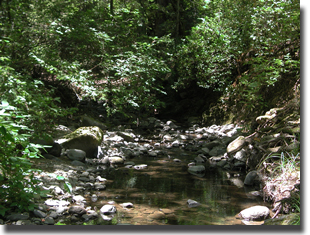
We expected to see the highest algae levels where we find high nutrient concentrations and poor quality physical habitat (e.g., low river or creek flow, high water temperature, and low canopy cover). Because algae growth tends to peak in late summer, we sampled sites in the late dry season (August/September), when we expected to find the most algae. These data helped us evaluate if nutrients were currently causing excessive algae growth in the watershed.
The data collected during the 2011 and 2012 dry seasons showed that nutrient concentrations, physical habitat quality, and algae biomass (as given by chlorophyll concentrations) were meeting water quality objectives or relevant benchmarks. Overall, very few sites showed high chlorophyll levels despite some moderate nutrient concentrations. Most, but not all, sites were below the chlorophyll thresholds thought to be protective of cold water beneficial uses (150 mg chlorophyll per square meter of stream bed). Algae need both nitrogen and phosphorous to grow and, usually, algae growth is limited by one of these two nutrients. In general, this watershed was nitrogen limited, meaning that changes in nitrogen concentrations were more likely to affect algae growth. The weather in 2011 was generally cool and wet, whereas 2012 was dry and warm. This sampling effort spanned a range of environmental conditions experienced in the Bay Area.
Delisting Approved by State Board
The State Board approved the delisting of Napa River for nutrients when they approved the 2018 Integrated Report at its October 20, 2020 Meeting. You can find out more about the 2018 Integrated Report by visiting this website.
Delisting: Resolution No. R2-2014-0006
The San Francisco Bay Regional Water Quality Control Board approved at its February 12, 2014 meeting a proposal to delist the Napa River for nutrients resulting in excessive algae growth and to remove this water body from the EPA 303(d) list. The staff report detailing recent water quality assessments, lines of evidence, and interpretation of data are available upon request. This delisting was included in the Integrated Report submitted to U.S. EPA for the 2018 listing cycle.
See our 303(d) page for more information about the 303(d) listing process.
- Delisting Summary: Resolution No. R2-2014-0006, Staff Report, Public Comments, Response to Comments (email staff contact below to receive via email)
- Napa Sonoma Nutrient Delisting Data (Excel)
- Napa Sonoma Continuous Monitoring Data (Excel)
For more information, contact:
Richard LookerSan Francisco Bay Regional Water Quality Control Board
1515 Clay Street, Suite 1400
Oakland, CA 94612
E-mail: Richard.Looker@waterboards.ca.gov

